
The Winter Olympics have been on in our house over the last couple of weeks.
Not in the “everyone sits quietly analysing technique” kind of way. More the “half watching while someone builds Lego, someone else asks for a snack, and I’m mentally drafting emails while pretending to relax” version.
Somewhere between the speed skating and a fairly impressive Lego tower construction project, something resonated with me.
Olympic athletes don’t train at peak intensity all day.
A downhill ski run might last two minutes. A biathlete steadies themselves for a single decisive shot. Everything they do is built around short, deliberate bursts of effort followed by recovery.
Watching it, alongside children who were very committed to rebuilding the same Lego structure three different ways, made me realise how differently most of us design our working days.
With Lego, if you rush or skip steps, the whole thing collapses and someone ends up crying (sometimes me!).
At work, we do something similar.
We stack meetings back-to-back. We respond in every gap. We try to think strategically when we’re already mentally running on fumes.
We expect sustained Olympic-level concentration without Olympic-level structure.
By late February, that tends to catch up with us.
This isn’t just anecdotal
CIPD’s Good Work Index¹ continues to highlight high workload intensity and rising digital presenteeism across UK professional roles. Hybrid working hasn’t reduced expectations – it has expanded responsiveness. The volume of communication has increased, but the protected thinking time hasn’t.
Layer onto that what neuroscience tells us about attention. Our brains naturally operate in ultradian rhythms – roughly 90-minute cycles of higher and lower alertness. After sustained deep focus, cognitive performance drops. Error rates increase. Decision quality declines.
If you’re feeling capable but mentally stretched, it’s probably not because you’ve lost your edge. It’s because your work design doesn’t respect how focus actually functions.
And that’s where this month’s tool comes in.

This months tool: Focus Sprint
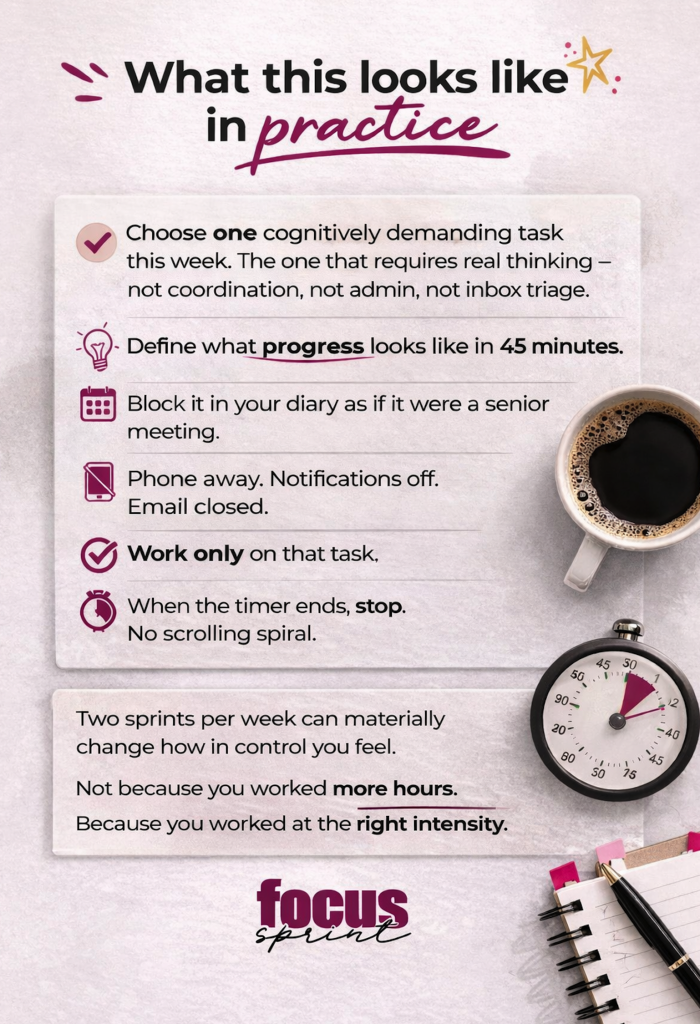
A Focus Sprint is a deliberately protected burst of deep, undistracted work with a defined objective and a defined stop point.
Not “catch up.”
Not “try to get ahead.”
Not “clear some emails.”
Specific. Measurable. Contained.
Here’s why they work.
First, they reduce cognitive switching. Every time you check Teams, email, or notifications, your brain pays a switching cost. It takes time to re-enter the original task. Sprints remove that option.
Second, they lower the psychological barrier to starting. Large, ambiguous tasks trigger avoidance. Committing to 45 minutes feels manageable. Finishing a strategy paper does not. Once you begin, momentum builds.
Third, they sharpen decision-making. A time boundary creates productive intensity. You stop polishing and start progressing.
Fourth, they build confidence. Ending a sprint with visible movement shifts you from “I’m behind” to “I’m advancing.”
That shift can be powerful.
📚 Cal Newport’s book Deep Work argues that the ability to perform focused work is becoming increasingly rare, and therefore increasingly valuable. He’s right. In a noisy, reactive environment, sustained attention is an advantage.
🎙️ Dr Andrew Huberman has also spoken extensively (including on The Diary of a CEO podcast) about attention cycles and why structured focus followed by deliberate recovery produces better long-term performance than constant output.
Olympians train in intervals because intensity without recovery leads to injury.
Professionals try to power through because Outlook looks full.
There’s a better way.
I developed this tool which forms part of the Self-Managed Success coaching programme, and now is the perfect time to experiment with it.
Self-Managed Success Win!
One of my coaching clients came into the programme feeling permanently busy but never quite ahead of things. Her diary was organised and nothing was falling through the cracks, but the week itself felt reactive, with thinking time constantly squeezed out by smaller demands.
Rather than introducing another system or adding more tools, we focused on structure. Together we built in Focus Sprints each week, creating dedicated space for strategic work and forward planning.
A few weeks later she described the difference simply:
“I know the structure of my week before it even starts.”
Nothing about her role or workload had changed. What shifted was how the work felt. With space to think and plan ahead, she moved from responding to the week as it arrived to shaping it in advance, and that made all the difference.
The Olympics may have finished, but the lesson has stuck with me.
Where in your work are you expecting yourself to perform at full speed all day without ever building in space to think?
As we head into March and everything inevitably starts to pick up pace again (hello end of Q1 approaching!), maybe the question isn’t how to push harder, but where to focus properly. You don’t need Olympic stamina, just a bit more structure around where your best thinking happens.
If you can, try one Focus Sprint over the next week and see what shifts.
Lauren x
Sources:
¹ CIPD Good Work Index – https://www.cipd.org/uk/knowledge/reports/goodwork/