
Post Christmas chaos, I spent some time away with the family, trading a cold Scottish winter for a few days in the sun. The pace was slower, the days simpler, and the change of rhythm came at just the right moment.
The pause gave me space to reflect, not just on what needed done next, but on how I was planning in the first place.
Instead of focusing on daily or even weekly lists, I decided to zoom out and plan the quarter as a whole. I also decided to stop separating work plans from life plans. Seeing everything together gave me a far more honest picture of what was realistic, what could wait, and what genuinely mattered.
That clarity was far more useful than adding more tasks to a list.
Coming back from that break, one thing stood out clearly. Most of the people I work with are already doing a huge amount of planning, prioritising, and decision making, but they’re doing it quietly, internally, and often alone.
They’re capable, trusted, and experienced, and they’re also carrying the work an assistant would normally hold. Remembering follow ups, juggling priorities, tracking loose ends. Holding the bigger picture in mind while everything else moves at pace.
That invisible work rarely gets named, but it’s often the most exhausting part of the day.
This edition of Organised Chaos is about recognising that effort, and exploring what it looks like to create clarity when you’re managing it all yourself.

The invisible work behind busy days
What I notice most when people feel stretched isn’t a lack of motivation. It’s the amount of mental effort happening before the work even begins. The thinking. The prioritising. The constant inner conversation about what matters most right now.
This invisible work doesn’t sit neatly on a to do list, but it quietly drains energy and focus. When everything lives in your head, organised chaos isn’t a failure, it’s an understandable outcome.
That experience is reflected in wider research too. Reporting in the ¹ Financial Times, drawing on European workplace studies, has highlighted that many professionals spend close to two full working days each week on routine administrative tasks. Chasing approvals. Managing inboxes. Duplicating work across systems. Updating documents.
Despite the growth of digital tools, relatively few people feel they spend most of their time on work that genuinely adds value.
It’s not that people aren’t working hard. It’s that too much is being carried mentally.
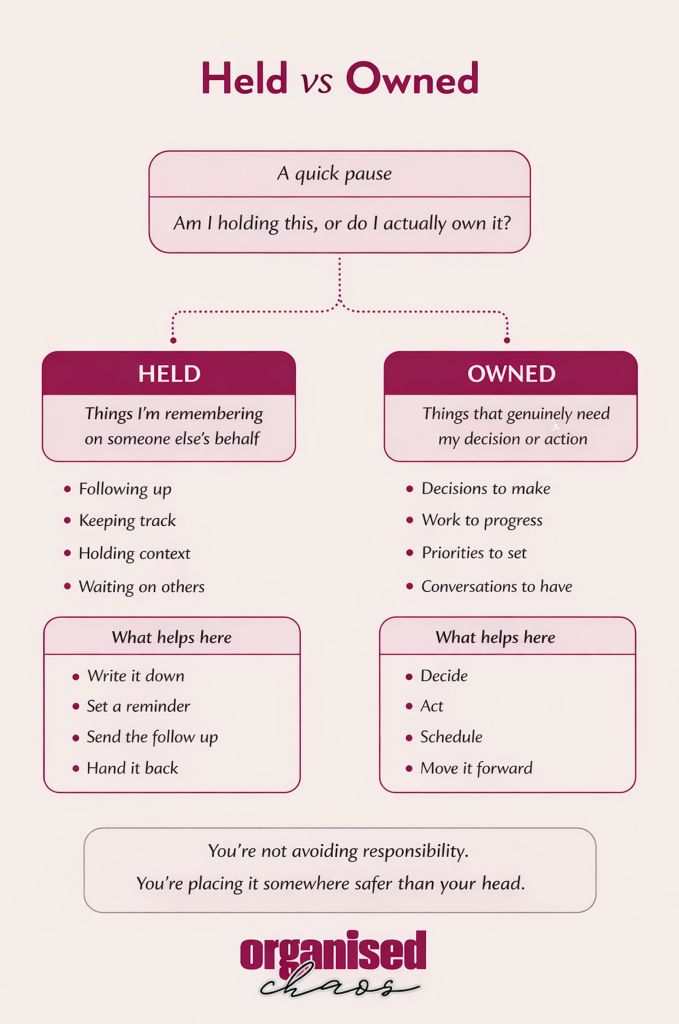
Reframe to try – Held vs Owned
Instead of another list or planning tool, here’s a simple reframe.
Ask yourself, Am I holding this, or do I actually own it?
Many of the things that take up mental space fall into one of two categories.
Owned, things that genuinely sit with you and need your decision or action.
Held, things you are remembering on someone else’s behalf.
That holding work is classic invisible assistant territory, and it’s often where mental load quietly builds.
Once you notice something you’re holding rather than owning, the assistant move is to externalise it.
Choose one or two things that have been sitting in your head recently, the kind that keep resurfacing or quietly take up space. Before doing anything with them, pause and run them through the diagram below.
The diagram is there to help you separate those two experiences and decide what deserves your attention, and what simply needs somewhere clearer to live.
What I’ve been listening to

🎧 Podcast: Good Hang with Amy Poehler
This month I’ve been drawn to things that feel light and grounding rather than demanding.
One favourite has been Good Hang with Amy Poehler. It’s not a productivity podcast, and that’s exactly the point. The conversations are warm, funny, and human, and they offer a genuine mental break without asking you to learn, improve, or optimise anything.
In busy seasons, that kind of pause matters more than we think.
A gentle start to the year
If the month already feels full, that’s not a sign you’re failing.
It’s a sign you’re carrying a lot, much of it unseen.
Sometimes the most supportive thing you can do is give yourself the structure an assistant would normally provide, even if that starts with one honest question and a place to put things down.
Less held in your head. Clearer ownership. More space to think.
We’ll continue to build on this in the next edition of Organised Chaos and in the meantime, a review of the previous tools shared so far may come in handy:
Lauren x